Sheltered International, Author at SiShips - Page 12 of 13

Skip to Content

Supply Chain Congestion as Truck Rates Increase, Ports See Packed Capacity

Recent Posts by Sheltered International

Supply Chain Congestion as Truck Rates Increase, Ports See Packed Capacity

Adjusting for Increased Truck Rates and Reduced Productivity

In a stark contrast to the shipping slowdown seen in the spring, ports in California are seeing significant surges of imports, operating at peak utilization. Subsequently, trucking rates have increased, reflecting the demand of companies looking to move products out of the ports and across the country.  At Sheltered International, our team is adapting to these increased rates, offering updated and flexible quoting options. Read on to learn more about current events impacting shipping, or contact us directly with questions regarding your shipment.

Ports Experiencing Peak Capacity

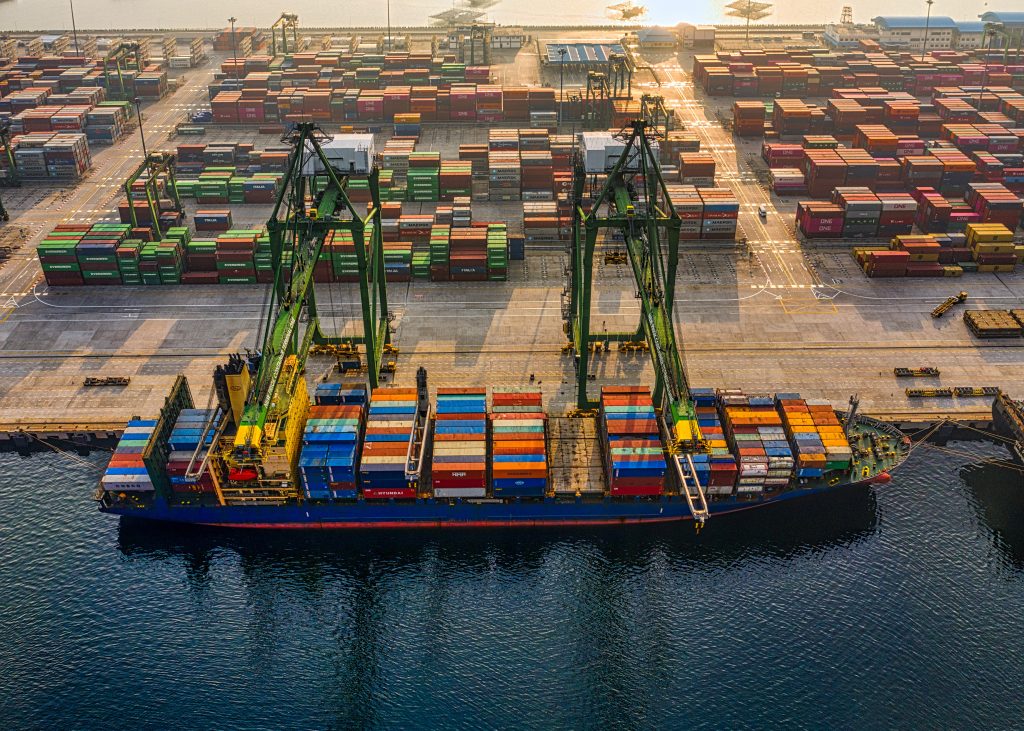
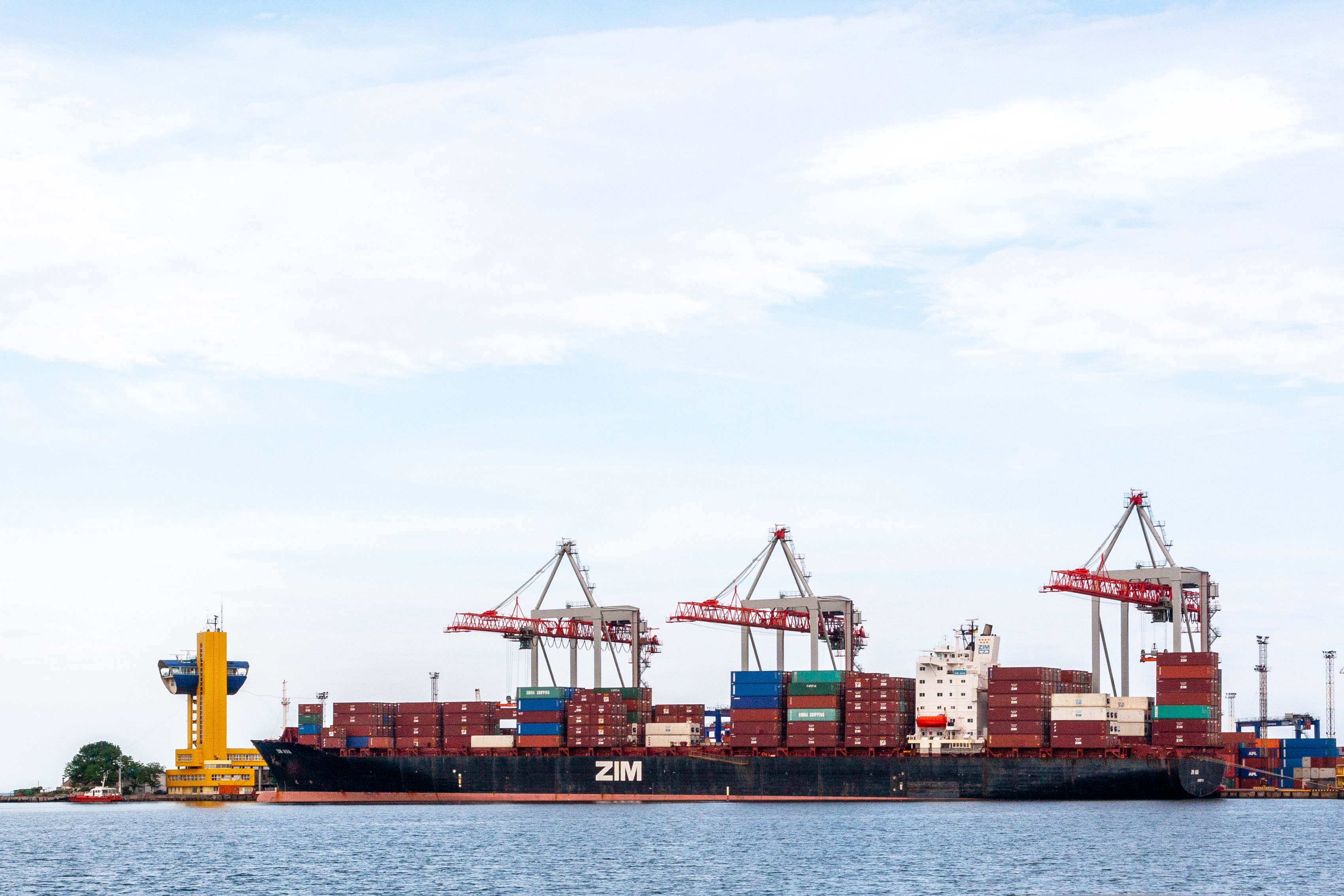
Demand for PPE, household wares, home exercise equipment, and other e-commerce goods shipped from Asia has stressed the capacity of ports in California, with LA and Long Beach operating at 105% capacity on peak days. As markets begin to reopen, Asian imports have increased 101% from March and year-over-year imports are up by 22%. With retailers eager to bring merchandise to the United States in advance of Lunar New Year and its respective shutdowns, ocean cargo capacity is being pushed even further.

Trucking Rates Increase

With port capacity pushed to the limits, terminal operators are unable to implement dual transactions and dray-offs, which typically are used to increase efficiency. As a result, truck turn times are on a steady decline, increasing from 58 minutes on average in June to 77 minutes in September. With reduced productivity, truck capacity is decreased, leading to a sharp spike in rates. Both truckload and less-than-truckload (LTL) rates are increased, with per mile averages up 54% from May and reaching $2.46.

Similarly, reduced productivity has increased container dwell times, consequently impacting port capacity to complete the cycle. As states reopen their markets at different times and with different regulations, demand varies significantly across the country; in conjunction with slowed delivery, this creates what Dean Croke, principal analyst at DAT iQ, calls a “network imbalance.”

How SiShips Can Help

During this heavy peak season, our team can provide your business with updated quotes. While we typically quote China-to-door delivery, we can now provide adjusted LA port-to-door quotes that reflect new rates. Alternatively, you may opt to select your own truck delivery method, using SiShips to obtain a port-to-port quote instead.

If you have questions, don’t hesitate to contact a member of our team. We’re here to provide you with the information you need to make the best freight forwarding choices.

Get in touch with us today for shipping support.

0 Continue Reading →

China’s Ministry of Transport Considers Ban on Rate Increases, Blank Sailings for US-China Trade Lanes

How China’s Intervention May Affect Capacity and Rates for Ocean Freight Long-Term

As ocean cargo rates continue to surge, China’s Ministry of Transport is taking steps to prevent any further increases. Last week, Chinese authorities discussed a possible ban on rate increases, which would apply to the GRI planned for mid-September. To boost capacity, they also suggested prohibiting the blanking of any sailings on the transpacific route, significantly impacting the ability of carriers to manage capacity and maintain a profit. Although nothing has been established as of yet, carriers and shippers alike should consider how this could impact their shipments.

China Ocean Freight Rates and Cargo Capacity

Increasing Rates Through Q2

In spite of COVID-19, ocean freight carriers around the world are seeing a year-over-year increase in profit. In fact, demand has made Q2 2020 the most profitable second quarter for carriers since 2010, with a total earned profit of $2.7 billion.

The China-US West Coast trade route has seen a particularly high demand, seeing rates soar by 146% YOY, as compared to the 21% increase seen on Asia-Europe routes. Despite carriers reinstating the majority of blanked sailings, demand is still outpacing capacity and an additional GRI was scheduled for mid-September. This rate increase would have been blocked by China’s ban. While the state-owned China Ocean Shipping Company (COSCO) and OOCL canceled rate increases – and Maersk was rumored to follow suit with rate cuts for both US west coast and east coast – most carriers have moved forward with a GRI. That said, the rate increases are lower than anticipated, suggesting China has had some influence.

Preventing Capacity Management

Adjusting capacity is crucial for freight companies to maintain revenue during times of flux. Although it’s anticipated that spot rates will unlikely to continue rising, thus making China’s ban on rate increases trivial, preventing carriers from adjusting capacity could have a significant impact. As the market slows, the inability for carriers to adjust could prevent them from stemming losses. “This would have an unprecedented impact on the market and, more worryingly, potentially derail the carriers’ ability to manage capacity in the face of extreme demand volatility,” said Lars Jensen of SeaIntelligence.

With so many factors impacting freight rates, it can be difficult to know if you’re getting the best price. That’s where SiShips comes in. Our software gives you instant access to auto quotes and custom quote options, allowing you to tap into our years of experience. That means less time spent worrying about your freight and more time to grow your margins.

To learn more about our software, contact us today.


2 Continue Reading →

Ocean Cargo Rates Peak as Demand Surges

Covid-19, Limited Capacity, and More Factors Have Driven Freight Rates to Set New Records

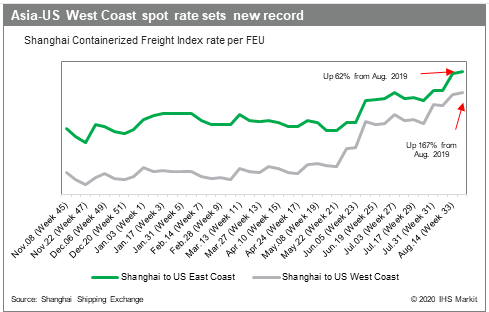
Although back-to-school season and holiday preparations consistently make August a peak season for ocean freight, this year is seeing a uniquely high increase – in both rates and capacity. The blanking of sailings earlier in the summer in response to the Covid-19 pandemic, combined with concerns over tariffs as the first trade agreement with China nears expiration, has generated a boom in demand that outpaces capacity. As a result, Asia-US West Coast spot rates have set new records, with Shanghai to US West Coast routes seeing a 167 percent increase from 2019.

Further, analysts are predicting another General Rate Increase (GRI) for trans-Pacific ocean cargo routes this month, marking the fifth since June 1. While earlier in the summer, increased rates were driven by significant numbers of blank sailings (a response to reduced exports from Asia due to Covid-19), these new GRIs are built on a surge of demand as inbound volume sees a year-over-year increase. We explored the factors at play in this increase, as well as potential future events that may impact rates further.

Spot Rates Increase Ocean Cargo

Capacity Versus Demand

Since the start of the year, capacity and demand have been drastically fluctuating. The onset of Covid-19 meant a sudden halt of economies, starting in China and Asia. With fewer imports – and lower consumer demand – carriers cut capacity radically, with 19 percent of total sailings blanked in May and 15 percent in June.

This summer, economies began to move again and US imports from Asia rose by more than 20 percent between June and July. In particular, a significant consumer demand for items like fitness equipment, at-home activities, and furniture, as well as the consistent demand for PPE, drove retailers to increase their imports to satisfy demand. Now, with only 3 West Coast sailings blanked for August and September, capacity is nearly back to normal – yet need for space is outpacing it. To combat this, carriers have added additional sailings from Asia, or “extra-loaders,” with 10 scheduled for August and an extra 5 for September; however, these additional sailings haven’t been enough to eliminate the capacity crunch, maintaining increased spot rates.

External Factors at Play

Beyond Covid-19, additional factors are also at play. Uncertainty surrounding the US-China trade deal has driven importers to bring their goods over from China earlier than normal, hoping to avoid the potential of a large tariff increase. Likewise, as the American election looms, importers and carriers alike are doing their best to anticipate potential shifts in the market.

Seasonal trends have also shifted – consumers are prioritizing furnishings and other goods for at-home use outside of their typical peak seasons and forgoing traditional purchases for this time of year like back-to-school gear or Halloween items.


We understand that tracking rates can be difficult. With years of experience in freight forwarding, we build our software SiShips. With this program, you can ensure your business is always receiving the best rate available – and get access to seamless cargo tracking, instant quotes, and more.

Contact us today to learn more about how SiShips can help streamline your import and export experience.


0 Continue Reading →

Save Your Business Valuable Time with SiShips’ Quoting Tools

Understanding SiShips Auto Quoting and Spot Quoting Options

With so many carriers and shipping routes available, finding the right quote for your shipment can be overwhelming. Even worse, countless back-and-forth emails takes time that would be better spent focusing on other areas of your business. Our software SiShips offers quoting tools that save you that time – and provide accurate, easy-to-filter quotes that give you the ability to find the best fit for your product. We provide both auto quotes and spot quotes and let you book and track both directly through our system. Read on to learn about the two quoting options and to discover how easy they are to use.

freight forwarding quoting software

Understanding Auto Versus Spot Quotes

The SiShips software can produce two different quotes: the auto quote and the spot, or custom, quote. Both options require basic information, including origins, destinations, product type, and weight. Once you input this, our system will quickly determine which type of quote is right for your freight. Standard shipments will receive instant results, while shipments that require additional information or special circumstances will be prompted to request a custom quote. No matter which type of quote you get, you can administer it through SiShips – just as easily as you track shipments, manage customers, and so much more.

How and When to Use Auto Quotes

Auto quotes are the right fit for a variety of overseas imports and exports, and can be applied to ocean cargo for both LCL and FCL shipments. Specifically, auto quotes for LCL cover imports from origin port to destination door and exports from origin door to destination port. Quotes for FCL cover imports from Asian origin ports to American doors and exports from American origin doors to main destination ports. Using the system to find a quote can save you several hours, instantly providing you with all pricing, carrier, and route options.

To get an auto quote using SiShips, all you need to do is select your mode and input your origin and destination. From there, our software does the rest. You’ll be presented with all of the details of each option and can filter by cost or route to find the best choice for you. Leaving the container size fields blank will show you all of your options, giving you extra flexibility and the power to make the best decision for your business. These quotes can be emailed or printed directly from the screen and can be booked instantly as well.

The video below shows how to use the SiShips software to build an auto quote. Please note that air cargo is not currently covered with our auto quotes, as the market is changing weekly. Find details below about custom quoting for air freight.

When to Use Custom or Spot Quotes

Not all shipments can fit under the auto quotes umbrella. For those that can’t be calculated automatically, SiShips will prompt you to create a custom quote. This applies to shipments that are oversized, overweight, or require door pick-up or delivery in locations outside of the United States. Additionally, due to currently fluctuating rates, all air freight quotes are also redirected to the custom quote feature. Our spot quoting ensures you’re quoted accurately and can stay on top of market changes.

The software will ask for as much information as you have available, including weight and dimensions. You can also add extra details, such as any deadlines or the shipment’s value, and upload any relevant files you may have. While not all of this information is required, more specifics allow our pricing team to create a faster and more accurate custom quote for your shipment.

Once you’ve submitted the form, the “View Quotes” tab will help you keep track of all of your spot quote requests, including those that have been booked. To ensure you get all the information you need, our team may reach out to contacts overseas for further details. As a result, our average time frame for a spot quote is 24-48 hours.

If you ever have any questions about your quote, whether auto or custom, please don’t hesitate to reach out to our pricing team at pricing@siships.com.

The video below shows how to use the SiShips software to build a custom quote.

With our software SiShips, you can streamline your freight forwarding experience. That means less time managing shipments and more time building your business. Contact us today to learn more.


0 Continue Reading →

Why Your Company Should Use Periodic Monthly Statements

How Sheltered International Makes Filing Duty Payments Easier for Your Business

From saving you time to improving your cash flow, using the Periodic Monthly Statement (PMS) process can offer significant benefits to your business. PMS has no additional cost and allows your business to pay duties monthly in a single payment, instead of for each individual transaction. Combined with our tracking and reporting software SiShips, your business can enjoy simplified reporting and accounting and a greater sense of control when it comes to duty payments.


How Do Periodic Monthly Statements Work?

Periodic Monthly Statements track entry activities throughout the month to provide a single monthly statement. This structure also extends the payment window. While when paying per shipment, the importer must pay duties within 10 business days, PMS offers the importer 15 business days after the end of each cycle to pay. For example, the duties on goods imported between July 1 and July 31 will be summed at the end of the month. The monthly payment is then not due until the fifteenth business day of the following month – in this example, August 21.

With this additional time, your business can extend cash flow by up to 54 days. The single payment not only makes it much easier to track your finances, but also offers significantly more control over your working capital.

How Can My Business Use PMS for Duty Payments?

Get started with PMS by filling out an application and sending it Sheltered International to review and submit to Customs. In a few weeks you will receive a Payer Unit Number (PUNS) from Custom’s ACH team. Once received, you must forward your PUNS number to Sheltered to complete the activation.

How Can SiShips Help?

To streamline the process even further, our software SiShips generates a duty summary (7501) for each entry throughout the month for accounting and record-keeping. Once the month has closed, a final statement will be provided to review before Customs pulls the duty on the 15th business day the following month. These reports can all be easily accessed through our software. That’s less time that you have to spend on accounting and more time you can devote to supporting your customers and growing your business.

With greater control over your cash flow and a simplified payment process, it’s clear that PMS can be valuable for you and your business.

To learn more about how Sheltered International can help finesse your freight forwarding experience, contact us today.

0 Continue Reading →

An Interview with Sheltered International Export Manager William Mosley

Why This Freight-Forwarding Expert Loves Living and Working in Amelia Island

After relocating to Amelia Island from South Carolina six years ago, William Mosley discovered two things: a love for the beach and a new work family at Sheltered International. As the Export Manager, William spends his day-to-day communicating with an array of customers – one of his favorite aspects of the job. Read on to learn a bit more about William, his favorite SI tools, and predictions for 2020.

Where are you from, and what is your role here at Sheltered International?

Export Manager Sheltered International

I am originally from Greenville, South Carolina, and my wife and I moved down here 5-6 years ago. I live around the corner from the office, and we love Fernandina. As the export manager here at Sheltered International, I do a little bit of everything – air freight, sea freight and export truck freight. I work directly with many of our customers and carriers.

How long have you worked at Sheltered International?

I’ve been here for 2.5 years, but I’ve been in this business since I was a kid. Long story short, my father-in-law got me a job when I was a teenager at a hospital where he was an administrator in shipping and receiving, and that’s when I started in the business. I worked within my previous position in Greenville for 28 years, but when my wife and I decided to move to Fernandina, I was able to find a great team to transition to at SI. We have a world of experience here, and I love the people that I work with.

What does your day-to-day entail?

I communicate directly with everyone from customers and overseas agents, to carriers and vendors. Every day is unique. We pride ourselves on being very customer-oriented, and that’s one of the aspects that I love about my job.

Why are you passionate about your job as Export Manager?

I feel like my job entails something new every day. I like promoting exports – I really think that exporting goods is patriotic. The U.S. happens to be the biggest consumer on earth – we are an import-oriented place. We get a lot of folks that come to us that are hesitant to try exporting goods for the first time, and I like to help walk through people through the process to help show that it can be done. Our job is to help guide clients to make the right moves.

What do you feel like is the most helpful online resource or tool Sheltered International offers within the platform?

Utilizing the tracking features we have available is an excellent way of being able to keep up what is going on with cargoes. We also have an instant rate tool, which is very handy. We do have a pricing team that handles the more complex quotations, but our customers are able to easily generate an estimate with the instant rate tool, and then refine it when they are ready to go. Our founder, Andrew Ciccarone has developed the platform so that there are a ton of great resources for both importers and exporters. We try to make everything as easy as possible.

Amelia Island Florida

What insights do you predict for 2020 within the shipping and transport industry?

Even though the U.S. has been somewhat shut down due to recent events, we are such a resilient country that I have no doubt that we will bounce back. We might be a bit slow to build export levels back up to where they were pre-coronavirus, but some of these things are going to move no matter what. Vessels may be lighter than normal, but they will still be there.

We have had a lot of customers impacted by the new tariffs, but it has not been quite as bad as the predictors have said. I don’t think 2020 will be all doom and gloom. Numbers won’t look great, but I believe we will be trending upwards.

What do you enjoy doing in your spare time?

You would think I would be tired of the beach, but I’m not! I go to the beach a lot, and enjoy spending time outdoors riding bikes. Maybe one day I’ll even dust off my fishing pole – we’ll see!


Exporting internationally for the first time can be daunting. Our software SiShips, built on years of expertise in the freight-forwarding industry, can streamline your experience, giving you more time to grow your margins.

Contact us today to learn more about how Sheltered International can ease your business’s transition into global markets.

0 Continue Reading →

COVID-19 Pandemic Continues to Affect Ocean Cargo Capacity

Blank Sailings and Fluctuating Demand Complicate Ocean Freight Forwarding

Lack of demand for ocean freight due to the COVID-19 pandemic has resulted in an increase in blank, or canceled, sailings of cargo ships. Though the number of cancellations peaked in February, major shipping companies are still reducing market capacity in an attempt to maintain freight rates. As carriers and shippers aim to strike a balance between fluctuating demand and capacity, it is more important than ever to be aware of the shifts in ocean freight availability and the impact it might have on your business.

blank sailings covid-19

Blank Sailings Increase in Q2

According to data from Drewry, May saw a total of 85 blank sailings out of 457 scheduled sailings, or a cancellation rate of 18.6 percent. For June, this rate decreases to 13 percent, with 58 of a planned 461 sailings have been canceled. Transpacific trade routes have experienced the greatest capacity reduction, with 47 percent sailings blanked.

Positively, cancellations have decreased month/month and the trend is expected to continue into July. However, Danish shipping company Maersk, part of the 2M Alliance, has still announced that it anticipates blanking more than 100 sailings within the upcoming third quarter. Its shares decreased by 6 percent mid-May as a reaction. 2M saw the second-highest number of suspended sailings in June at 34 percent, closely following THE Alliance’s 40 percent.

An Increase in Ocean Freight Demand

Frustrations with lack of airfreight capacity and high rates have been driving shippers to turn to the ocean, at least for a portion of their freight’s journey. “When rates go up, sea-air becomes a viable alternative for cargo that cannot pay high airfreight rates, nor accept all-ocean transit times,” Morten Bach, global chief commercial officer for Shipco, told FreightWaves.

As shippers adapt to account for available capacity, ocean freight demand is increasing. The American Journal of Transportation attributes this surge to the growth of eCommerce, as well as moves to distribute PPE via ocean to relieve shortages. Combined with a greater number of blank sailings, this has generated an uptick in freight rates. The last week of May saw prices jump by 12 percent.

Managing Ocean Freight with SiShips

Supported by a downward cancellation trend, predictions for July show that container-ship carriers are likely to offer more sailings in July. However, despite signs that industry may be starting to resume, industry experts are remaining realistic about the likelihood of a peak season in 2020. The upcoming back-to-school months should bring about a surge of demand, but most think this is unlikely. “There is concern for the ocean shipping industry that a peak season may not materialize at all this year,” Rachel Shames, director of pricing and procurement at CV International, said in an interview with Furniture/Today.

Without an increase in demand spurred on by a peak season, carriers will need to be cautious about continuing to maintain their rates. As a result, it’s likely that blanking will continue well into Q3.

With many factors influencing ocean freight, importing can quickly grow confusing. SiShips, designed with our years of customs and freight forwarding expertise, can help manage variable rates and shipping options. Plus, you can track your shipment every step of the way, offering transparency and peace of mind.

To learn more about how SiShips can save you time and streamline your shipping experience, contact us today.

0 Continue Reading →

SiShips Introduces Satellite Tracking for Ocean Cargo

What You Should Know About Satellite AIS Tracking and How It Can Help Your Business

satellite ais tracking

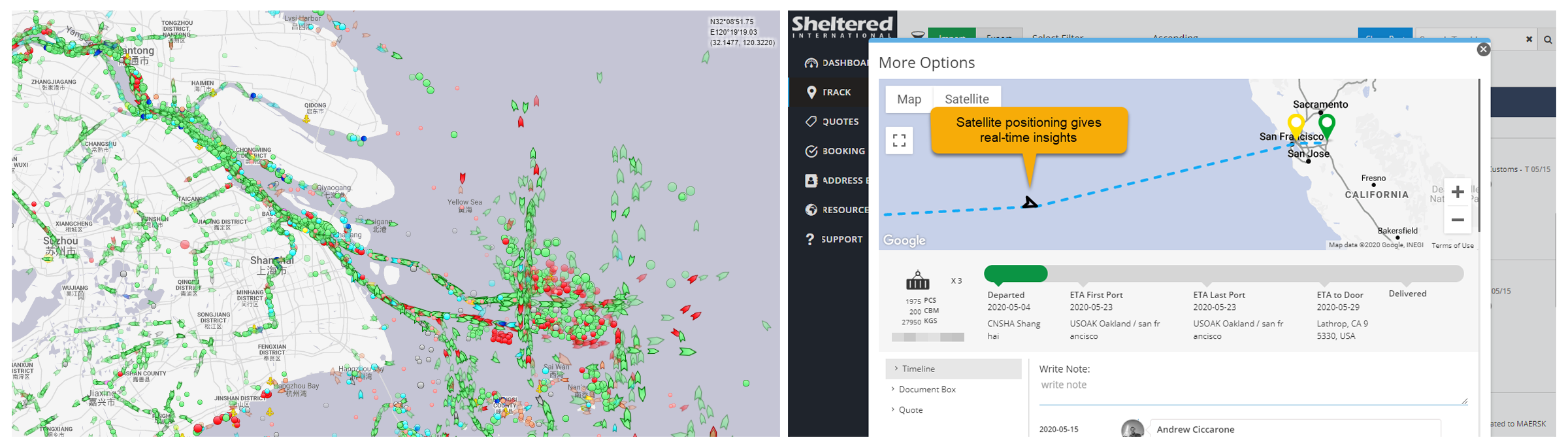
From inclement weather to pandemics, there is a myriad of external factors that can affect your shipment. Knowing where your cargo is at all times offers peace of mind. SiShips has integrated with Satellite AIS tracking to expand its freight tracking capabilities, allowing users to check the position of their ocean cargo with accuracy and ease. This update, provided at no additional cost for customers, offers additional transparency throughout the import and export process, along with valuable data that can be used to optimize shipping procedures.

What Is AIS Tracking?

Automatic Identification Systems, or AIS, are used to track ships at sea. While previously, these systems were limited to terrestrial, or T-AIS tracking, satellites, or S-AIS, provide more expansive tracking coverage. The two methods work together to create a complete, global picture of ship locations. This tracking system is vital to preventing collisions on busy marine routes but can also be used as a means of shipment management.

How SiShips Tracks Your Cargo

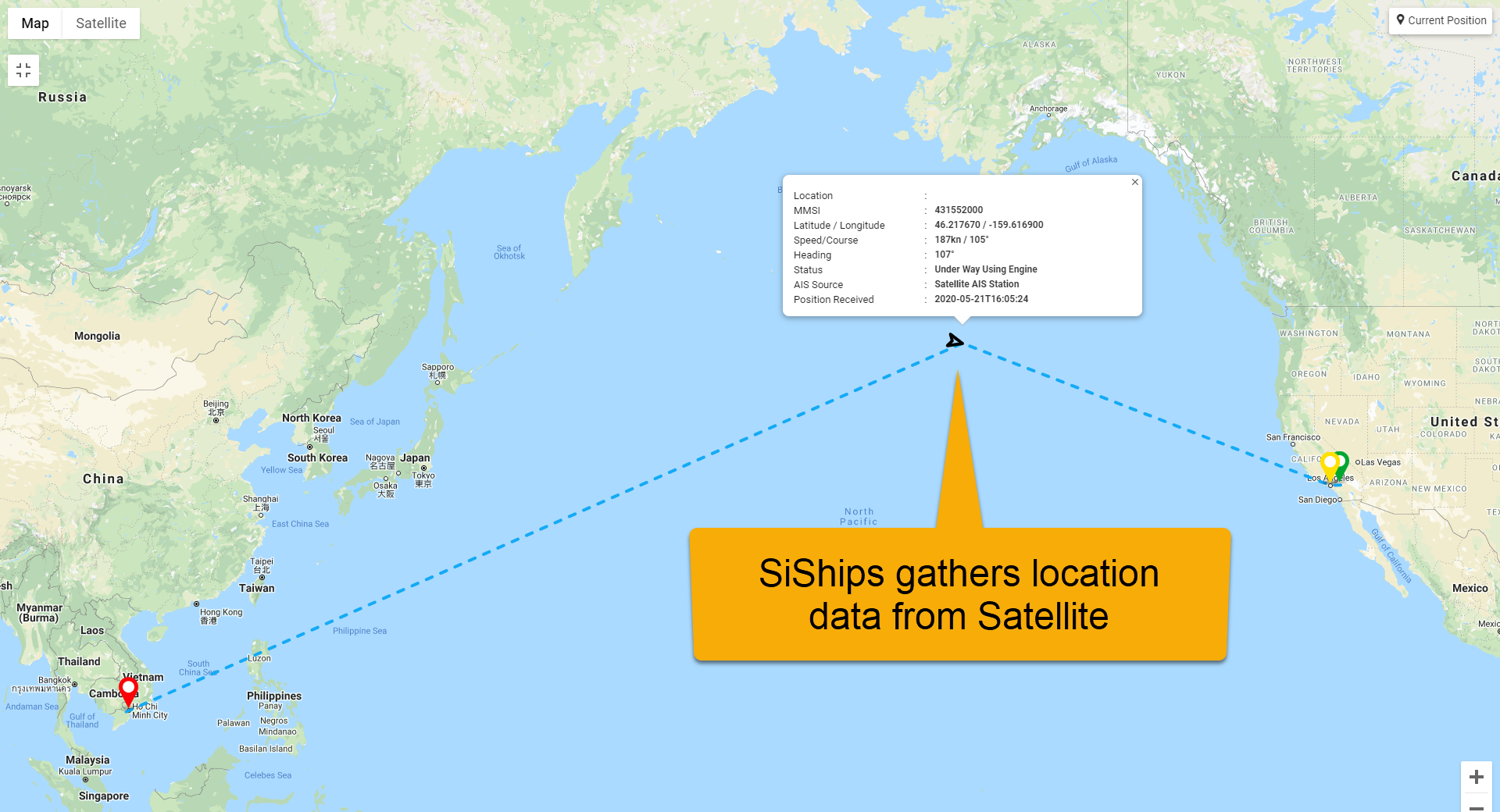
While your cargo is at sea, SiShips gathers location data from three leading Satellite AIS providers, ORBCOMM, exactEarth, and Spire. These satellites account for a network of 202,848 vessels, allowing you to track your freight anywhere in the world.

The SiShips software automatically checks and updates the ocean freight’s position multiple times per day, providing real-time insights as well as additional information. A report from the satellite includes the ship’s identification number, or MMSI, its current position, and the direction it’s progressing in. It also offers information about the ship’s speed and details about its status, such as whether or not the engine is being used. We put this information together to give you a complete visual picture of your shipment’s journey, as well as its ETA to each checkpoint. Once your freight is near land, the tracking transitions to a terrestrial AIS system, which is more accurate but limited in range.

satellite ais tracking siships

The Value of Data in Shipment Tracking

Because it was implemented in 1974, there are vast amounts of historical AIS data. This detailed information can be used to anticipate problems, optimize plans, and plan future shipment strategies. With the volumes of data transmitted by these systems, combined with SiShips’ extensive customs and shipment management framework, our software can help businesses apply these insights to manage logistics, reduce costs and react more quickly to disruptions or changes. With more data, your business can improve efficiency, saving you money and reducing stress. Ultimately, with less time spent worrying about your freight, you can get back to the bigger picture: building your business and increasing your margins.


To learn more about how SiShips can save you valuable time and streamline your freight experience, contact us today.

0 Continue Reading →

How a Partnership with Sheltered International Can Grow Your Business Internationally

Gain Support and Build Customer Relationships with Sheltered International

Though international expansion can often mean untapped business opportunity, many domestic shipping providers don’t have the expertise or resources to take this step. Delivering years of experience in the international shipping industry, Sheltered International can help. With support, training, and access to our white-label software SiShips, small businesses can grow globally. Read on to learn how partnering with Sheltered International can instantly streamline your international expansion.

Simplifying International Expansion for Independent Businesses

international shipping sishipsOur technology platform SiShips simplifies all steps of global shipping, from quoting to tracking to billing. With the software, agents and their clients gain freight forwarding and customs brokerage services in 819 cities across 190 countries. This also makes it possible to produce instant international quotes for shipments, providing clients with the information they need immediately. Questions or obstacles are managed by Sheltered International’s team of industry experts, who are always available to provide support and training.

Plus, SiShips includes powerful tracking technology, allowing the user to track and manage both ocean freight and air freight shipments internationally. With this straightforward freight management, agents can increase sales and expand their business, leveraging relationships with existing customers to serve their international needs. Even better, agents that partner with Sheltered International can also earn a commission, just for using and sharing this software. “Our reps are among the best and brightest in the country,” says Sheltered International President Andrew Ciccarone, “Every day I’m amazed to see how their dedication to customer service. It’s this passion that connects Sheltered with opportunity in countless industries and global supply chains; and vice versa.”

How Our Partner Easy Logistics Management Uses SI Ships

Jeremy Curran, owner and founder of Easy Logistics Management is one of Sheltered International’s partners. While his company utilizes a variety of software programs, he believes SiShips is unique. “I personally haven’t seen a product like that,” he says, “The all-in-one-screen platform – it’s like Travelocity for global logistics.”

Jeremy’s choice of Travelocity for comparison isn’t surprising; he’s an avid traveler, and his passion for adventure has guided his niche in logistics management. He specializes in working with industries that align with his passions, including surf and paddleboards, bikes, solar energy equipment, and snow sports equipment. SiShips has helped him simplify complicated international shipping and offer clients a global range of options. Key to growing his business is the ability to communicate simply and understand client needs, answering questions, determining customer pain points, and identifying what needs fixing seamlessly.

“The ability to see international and global logistics in real-time is a huge selling point. It makes it easier to articulate the value proposition to the clients, visually showing them the tool and how it rates,” he says. After working as an outside sales rep for a large shipping company for three years, Jeremy set out on his own in 2009. His team works remotely, so SiShips’ visual nature has made it easier to communicate and grow the company. He says that software development, which has made business easy, scalable, and transparent, is central to his staying in logistics. “None of us work in the same office,” he says, “If we were still faxing, I don’t think I’d still be doing this.”

Using Technology to Streamline Freight Forwarding

Jeremy is just one of many agents who have discovered the power of our technology. From California to Florida, our domestic partners have enjoyed a streamlined freight forwarding experience, bolstered by extensive systems of knowledge and support. With SiShips’ transparency and expert-designed interface, global expansion is more attainable than ever before, easing the stress of growing your business and giving you more time to develop long-lasting relationships with customers.


If you’re an independent shipping agent or logistics manager and you’d like to expand your business internationally, contact us today to learn more about SiShips can work for you.

0 Continue Reading →

COVID-19 Reduces Passenger Flights, Air Cargo Space

Airlines Adapt to Maintain Supply Chains Despite Decreased Airfreight Capacity

As the COVID-19 pandemic and subsequent quarantine orders reduce the number of passenger flights, air cargo space has been severely limited. Decrease in airfreight volume and supply has also generated a significant rise in rates, further complicating the importation of goods. This situation, along with the continued demand for PPE, medical supplies, and other essential goods, has required airlines to adapt, reconfiguring passenger planes for the transportation of cargo in an attempt to maintain supply chains.

A Sharp Decrease in Air Traffic

air cargo covid-19

While passenger planes typically carry cargo strictly in their cargo holds, the reduction in flights has limited transportable volumes. Even though some planes are still flying – often with just a handful of passengers – the drastic decrease in demand has forced a cut in flight offerings. In the final week of March, commercial air traffic was 55 percent lower than in 2019. Total air traffic has seen a 60 percent global reduction. Though planes are still in the air, they are primarily flying domestic routes, not international ones. In the United States, there were 72 percent fewer scheduled international flights in the first week of April as compared to 2019.

The Effects on Airfreight

As a result, airfreight traffic has fallen; the volume decreased by 10 percent in February and is predicted to fall by a total of 15-20 percent for the year, according to the International Air Transport Association. This was heavily influenced by the grounding of flights to China and the country’s shut down of factories earlier in 2020.

However, despite a 1.9 percent decrease in airfreight volume in February, freight capacity likewise fell by 4.4 percent, forcing a shortage of space. With a lack of available capacity, freight rates are increasing. These rates are particularly volatile between North America and Europe, given the previous reliance on passenger planes for these routes specifically. Industry experts suggest costs have increased by 4 or 5 times.

Passenger Planes Reconfigured for Cargo

Increased demand for personal protective equipment has forced airlines to find creative solutions to maintain the supply chain. In an attempt to provide more space, passenger planes are being converted to cargo planes. Air-safety regulators have reduced restrictions, allowing the cargo to be held in the cabin as well as in the belly of the aircraft for more efficient flights. Air Canada has scheduled 20 all-cargo flights per week using reconfigured Boeing 777s. Delta and United Airlines, among others, are also operating freight-only charters, often with added routes. These flights will prioritize medical supplies, food and other time-sensitive items.

“Operating regularly scheduled cargo flights means suppliers in China can get these supplies to hospitals and healthcare facilities across the US within hours, no the days or weeks it would take via cargo ship,” said Shawn Cole, Vice President of Delta Cargo. Delta’s flights are striving to maintain the supply line between the US and China, where a majority of PPE is currently manufactured.

With these adjustments, transporting goods is more unpredictable than ever. With years of expertise in the freight industry, Sheltered International is available to help importers streamline their air cargo experience and get their products up in the air quickly.

Contact us today to learn more about how we can help minimize shipping complications.

1 Continue Reading →


Recent Comments by Sheltered International

    No comments by Sheltered International